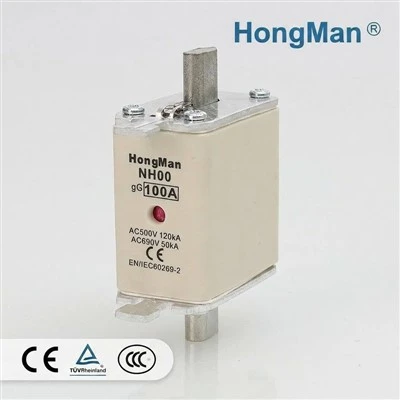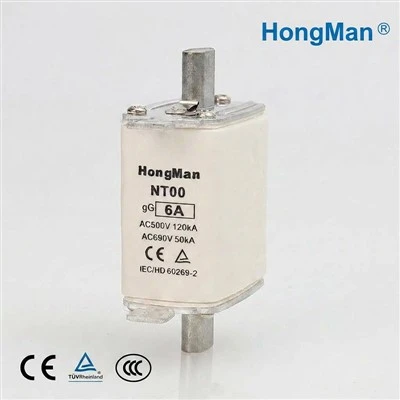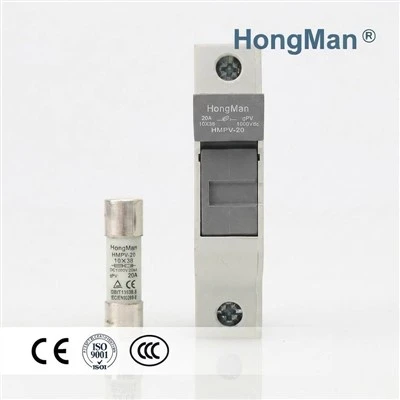

Both fuses and circuit breakers provide short-circuit protection. The principle of a fuse is that current flowing through a conductor heats it up, causing it to melt and break the circuit, protecting appliances and wiring from damage. It works by accumulating heat, thus also providing overload protection. Once the fuse element burns out, it must be replaced.
Circuit breakers also provide short-circuit and overload protection, but on a different principle. They use the magnetic effect of current (electromagnetic trip unit) to break the circuit and the thermal effect of current to provide overload protection (not melting, so replacement is usually unnecessary). In practice, when the electrical load in a circuit approaches the fuse's load capacity for an extended period, the fuse gradually heats up until it melts. As mentioned above, the melting of a fuse is a result of the combined effect of current and time, providing one-time protection. A circuit breaker, on the other hand, automatically disconnects when the current in the circuit suddenly increases, exceeding the circuit breaker's load capacity. It protects against instantaneous current surges, such as large leakage currents, short circuits, or large instantaneous currents. Once the cause is identified, the circuit breaker can be closed and service can continue. As mentioned above, the melting of a fuse is the result of the combined effect of current and time, while a circuit breaker will trip as soon as the current exceeds its set value, and the effect of time is almost negligible. Circuit breakers are commonly used components in low-voltage power distribution. Fuses are also suitable in some applications.