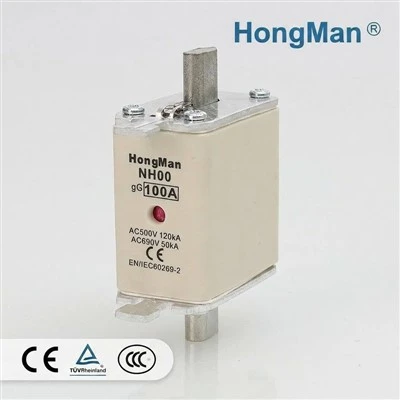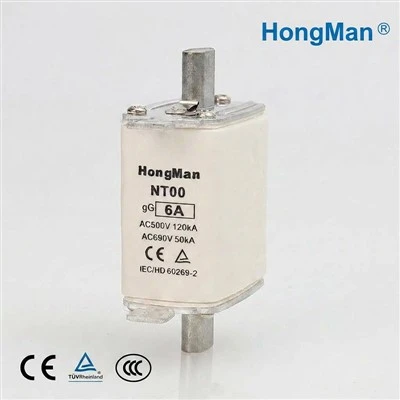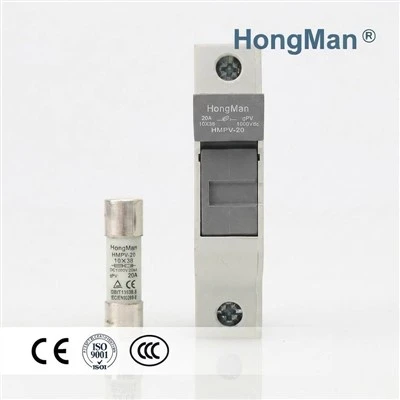

In terms of materials and processes, the core materials of photovoltaic fuses include a fuse tube made of high-strength ceramic material and a fusible element made of high-purity silver alloy. The fusible element is precision laser-cut to ensure stable fusing characteristics. The fuse tube is filled with chemically treated high-purity quartz sand as an arc-extinguishing medium to quickly extinguish the arc and improve breaking efficiency. The two ends of the fusible element are firmly electrically connected to the contacts by spot welding.
The core performance characteristics of photovoltaic fuses are designed to meet the challenges of rapid protection under high voltage and high current conditions in photovoltaic systems. Their series of products typically feature high withstand voltage, high breaking capacity, and wide temperature adaptability. The products can operate in a wide temperature range (-40~120) °C and have good short-circuit protection and excellent current-limiting capabilities.
These technological innovations enable the products to maintain stable time-current characteristics within a wide temperature range of -40℃ to 85℃. For example, at 100% of the rated current, the fuse should not blow within 4 hours; at 105% of the rated current, the minimum blowing time can reach 1 hour; and at 200% of the rated current, the maximum blowing time does not exceed 120 seconds, thus precisely balancing the contradiction between "false tripping" and "protection speed".